We Use CookiesWe use cookies to enhance the security, performance, functionality and for analytical and promotional activities. By continuing to browse this site you are agreeing to our privacy policy

10 Best Solar Charger Controllers 2025 in the United States

How do we rank products for you?

Our technology thoroughly searches through the online shopping world, reviewing hundreds of sites. We then process and analyze this information, updating in real-time to bring you the latest top-rated products. This way, you always get the best and most current options available.

headphones-stars

Our Top Picks

#1

Winner

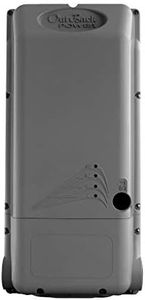
OUTBACK POWER 80AH MPPT Controller

The OUTBACK POWER 80AH MPPT Controller is a high-quality charge controller designed to improve the efficiency of your solar power system. As an MPPT (Maximum Power Point Tracking) controller, it adjusts to the optimal power point for maximum energy collection, which generally provides better efficiency compared to PWM (Pulse Width Modulation) controllers. It supports a voltage rating of 61 volts (DC) and an 80-amp current rating, making it suitable for large solar power setups.

The controller is built with durable materials like aluminum and ABS plastic, ensuring longevity and robustness in various environments. Weighing 12.2 pounds, it's relatively heavy, which might be a consideration for some users when installing it. The product comes with an LED display, which aids in monitoring the system’s performance and status easily, though more advanced display options like LCD might offer additional insights.

Protection features are not explicitly detailed in the brief, but products from Outback typically include essential protections against overcharging, over-discharging, and short-circuiting. Despite its higher weight and potential lack of advanced display options, the OUTBACK POWER 80AH MPPT Controller stands out for its efficiency, durability, and reliable performance in managing solar energy systems.

#2

Victron Energy SmartSolar MPPT Solar Charge Controller (Bluetooth) - Charge Controllers for Solar Panels - 150V 35 amp 12/24/36/48-Volt

Rating
10.0
Type (PWM vs MPPT)
Voltage Rating
Display and Monitoring

Most important from
790 reviews

Type (PWM vs MPPT)
This MPPT controller delivers consistent, high-quality performance across various configurations and battery voltages.
Voltage Rating
It reliably charges 12, 24, 36, and 48-volt batteries, adapting well to different solar array setups with smart voltage management.
Display and Monitoring
The Bluetooth-enabled app provides intuitive control and monitoring, allowing easy adjustment of charging parameters from your phone.
Protection Features
The controller can wake up deeply discharged LiFePO4 batteries and resume charging automatically, ensuring dependable battery recovery.
Efficiency
Victron’s reputation as the standard for solar charge controllers is well-earned with this efficient and user-friendly device.

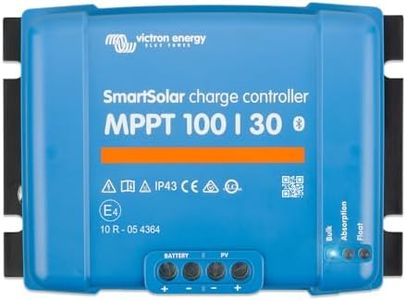
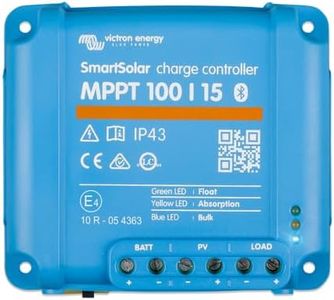
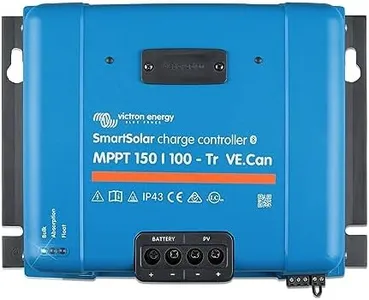
The Victron Energy SmartSolar MPPT 150V 35 amp solar charge controller is a strong choice if you want efficient solar charging with smart features. As an MPPT type, it excels at maximizing power output from your solar panels, even in less-than-ideal conditions like shading. It supports multiple battery voltages (12/24/36/48V), making it flexible for different systems. The 35-amp current rating and 150V voltage capacity are solid for medium-sized setups, fitting well for home or small off-grid systems.

One of its key strengths is the Bluetooth connectivity paired with the VictronConnect app, allowing you to easily monitor real-time data, check 30-day performance, and adjust settings from your phone. This makes managing your solar setup straightforward, especially if you want to track battery health and system efficiency without extra tools. The controller also offers synchronized charging when multiple units are used, enhancing battery life and energy optimization in larger systems. Protection features like automatic load disconnection help prevent battery damage by cutting power if voltages fall too low, adding a layer of safety.

On the downside, while the plastic build keeps it lightweight, it may not feel as rugged as metal-bodied controllers, which could be a consideration for harsh outdoor conditions. Additionally, with its price point and features, it may be more than necessary for very small or basic solar systems. For those wanting a reliable, smart, and efficient solar charge controller with good monitoring and safety features, the Victron SmartSolar MPPT meets these needs well.

Rating
10.0
Type (PWM vs MPPT)
Voltage Rating
Display and Monitoring

Most important from
790 reviews

Type (PWM vs MPPT)
This MPPT controller delivers consistent, high-quality performance across various configurations and battery voltages.
Voltage Rating
It reliably charges 12, 24, 36, and 48-volt batteries, adapting well to different solar array setups with smart voltage management.
Display and Monitoring
The Bluetooth-enabled app provides intuitive control and monitoring, allowing easy adjustment of charging parameters from your phone.
Protection Features
The controller can wake up deeply discharged LiFePO4 batteries and resume charging automatically, ensuring dependable battery recovery.
Efficiency
Victron’s reputation as the standard for solar charge controllers is well-earned with this efficient and user-friendly device.
#3

Morningstar Tristar 60A MPPT Solar Charge Controller 12V/24V/48V Batteries, Solar Panel Controller Battery Controller Solar Controller 12V 24V, Lowest Fail Rate MPPT Charge Controller for Solar Panels

Rating
9.4
Type (PWM vs MPPT)
Voltage Rating
Display and Monitoring

Most important from
309 reviews

Type (PWM vs MPPT)
MPPT technology in this controller showed a 16% increase in output compared to a PWM charger, making it essential for those with serious solar power needs.
Voltage Rating
Installation is clearly laid out in the manual, and the factory default charge programs cover most battery charge point voltages, making setup straightforward.
Display and Monitoring
The software is easy to use and provides important diagnostic and statistical information, making it an excellent piece of professional quality equipment.

The Morningstar Tristar 60A MPPT Solar Charge Controller (TS-MPPT-60) is designed for larger solar systems with high-voltage outputs and multiple panels. It is an MPPT type controller, which is generally more efficient compared to PWM controllers, boasting up to 99% efficiency. This high efficiency helps in optimal energy harvest and faster charging times. It supports a wide range of battery voltages (12/24/36/48V), making it versatile for various solar setups.

The controller includes comprehensive electronic protections, such as surge, short-circuit, overload, and reverse polarity protections, which safeguard against potential damage and ensure reliability. It also provides advanced self-diagnostics to notify users of any operational errors and automatic recovery features for continuous protection. The unit allows for extensive monitoring and data logging through MODBUS protocol and MS View software, and it can send email and text alerts, making it user-friendly for remote management.

The remote temperature sensor ensures accurate battery temperature readings, which is crucial for efficient charging. On the downside, the product is relatively heavy at 9.2 pounds and may require professional installation due to its complexity. Despite these drawbacks, its robust build, high efficiency, and extensive protection features make it an excellent choice for mission-critical applications or users with larger solar setups who need reliable and efficient energy management.

Rating
9.4
Type (PWM vs MPPT)
Voltage Rating
Display and Monitoring

Most important from
309 reviews

Type (PWM vs MPPT)
MPPT technology in this controller showed a 16% increase in output compared to a PWM charger, making it essential for those with serious solar power needs.
Voltage Rating
Installation is clearly laid out in the manual, and the factory default charge programs cover most battery charge point voltages, making setup straightforward.
Display and Monitoring
The software is easy to use and provides important diagnostic and statistical information, making it an excellent piece of professional quality equipment.

Buying Guide for the Best Solar Charger Controllers

When choosing a solar charger controller, it's important to understand that this device is crucial for regulating the power going from your solar panels to your batteries. It ensures that your batteries are charged efficiently and safely, preventing overcharging and extending their lifespan. To pick the best solar charger controller for your needs, you should consider several key specifications that will determine its compatibility and performance with your solar power system.
Type (PWM vs MPPT)There are two main types of solar charger controllers: PWM (Pulse Width Modulation) and MPPT (Maximum Power Point Tracking). PWM controllers are simpler and less expensive, making them suitable for smaller systems with lower power requirements. MPPT controllers are more efficient, especially in colder conditions and when the solar panel voltage is significantly higher than the battery voltage. They are ideal for larger systems where maximizing energy harvest is crucial. Choose PWM for basic, cost-effective setups and MPPT for more advanced, high-efficiency systems.
Current Rating (Amps)The current rating of a solar charger controller indicates the maximum amount of current it can handle from the solar panels to the batteries. This is important because it needs to match or exceed the current output of your solar panels to prevent overheating and damage. Controllers typically range from 10A to 60A or more. For small setups, a 10A to 20A controller might suffice, while larger systems may require 30A to 60A or higher. Assess the total current output of your solar panels and choose a controller with a suitable rating.
Voltage RatingThe voltage rating of a solar charger controller must match the voltage of your battery bank. Common ratings include 12V, 24V, and 48V. Some controllers are versatile and can handle multiple voltages. Ensuring the voltage compatibility is crucial for the efficient and safe operation of your solar power system. If you have a 12V battery bank, choose a 12V controller; for a 24V system, a 24V controller, and so on. For systems that might expand in the future, consider a controller that supports multiple voltages.
EfficiencyEfficiency refers to how well the controller converts the energy from the solar panels to the battery. Higher efficiency means less energy is wasted during the conversion process. MPPT controllers generally offer higher efficiency (up to 98%) compared to PWM controllers (around 75-80%). If maximizing energy harvest is important for your application, especially in areas with less sunlight, opt for a high-efficiency MPPT controller. For simpler, less critical applications, a PWM controller might be sufficient.
Display and MonitoringMany solar charger controllers come with built-in displays or the ability to connect to external monitors or apps. These features allow you to monitor the system's performance, including current, voltage, and battery status. This is important for maintaining and troubleshooting your system. Basic controllers might have simple LED indicators, while advanced models offer detailed LCD screens or smartphone connectivity. Choose a controller with the level of monitoring that matches your need for oversight and control.
Protection FeaturesProtection features in a solar charger controller safeguard your system against potential issues like overcharging, short circuits, reverse polarity, and over-temperature. These features are crucial for the longevity and safety of your batteries and other components. Look for controllers that offer comprehensive protection to ensure your system runs smoothly and safely. For critical applications, prioritize controllers with robust protection features.

FAQ