We Use CookiesWe use cookies to enhance the security, performance, functionality and for analytical and promotional activities. By continuing to browse this site you are agreeing to our privacy policy

4 Best Gen 2 Night Vision Monocular 2025 in the United States

How do we rank products for you?

Our technology thoroughly searches through the online shopping world, reviewing hundreds of sites. We then process and analyze this information, updating in real-time to bring you the latest top-rated products. This way, you always get the best and most current options available.

headphones-stars

Our Top Picks

#1

Winner

ATN NVMPAN1430 NVM14-3 Gen 3 Night Vision Multi Purpose Monocular, Black

Rating
10.0
Chosen by1,427
Image Intensifier Tube
Resolution

Most important from
5 reviews

Image Intensifier Tube
Basic Gen-3 tube with zero blemishes offers excellent value, especially considering the sub-$2600 price point.
Resolution
Some users may find the visualization under certain lighting conditions less impressive than expected for a higher-end unit.

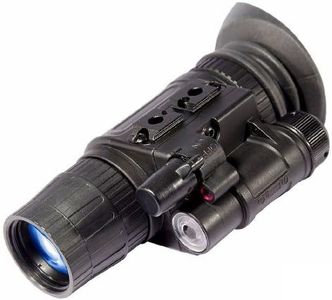
The ATN NVMPAN1430 NVM14-3 is a Gen 3 night vision monocular that stands out in the night vision category with its military-grade materials and robust construction. It offers a minimum magnification of 1x and a 25mm objective lens diameter, which are ideal for general hunting and tactical uses.

The monocular comes with a relatively lightweight design, weighing about 1 pound, making it easy to carry and handle. The field of view of 41 degrees is decent, allowing you to see a broad area in the dark. It is designed to be mounted on a handgun, adding versatility for tactical operations and hunting activities.

The product dimensions (3.4 inches long, 10.3 inches wide, and 10.3 inches high) make it compact enough for convenient transport and use in various situations. The limited lifetime warranty ensures some level of trust and reliability. The eye relief of 15mm provides a comfortable viewing experience without straining your eyes. It is well-built to withstand harsh environments, adding to its durability and weather resistance. One notable drawback is its package weight of 1.565 kilograms, which could be a bit heavier when considering portability over long periods. Additionally, with a best sellers rank of #1,303,647 in Sports & Outdoors, it may not be the most popular option in the market, possibly due to its age or the specificity of its use.

Rating
10.0
Chosen by1,427
Image Intensifier Tube
Resolution

Most important from
5 reviews

Image Intensifier Tube
Basic Gen-3 tube with zero blemishes offers excellent value, especially considering the sub-$2600 price point.
Resolution
Some users may find the visualization under certain lighting conditions less impressive than expected for a higher-end unit.
#2

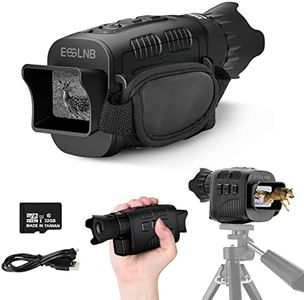
ESSLNB Night Vision Monocular 4X Infrared Monocular 960P with 32G TF Card 656ft Digital Night Vision Goggles Taking Photos Videos and Playback Function

Rating
7.9
Magnification

Most important from
185 reviews

Magnification
Zoom capability is modest, yet sufficient for typical night vision tasks without expecting long-distance detail.

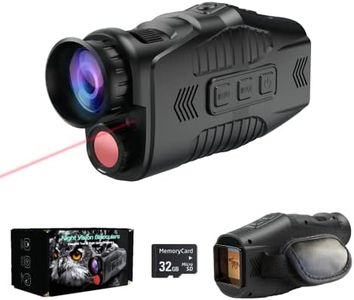
The ESSLNB Night Vision Monocular offers a good balance of features for casual night observation, such as wildlife watching or outdoor adventures. It provides 3x optical magnification with an additional 4x digital zoom, which helps you see details clearly up to about 656 feet away in total darkness thanks to its 3W infrared LED with adjustable brightness. The 1.5-inch LCD screen and high-resolution 1280x960 CMOS sensor allow you to capture photos and videos, and playback is easy right on the device. It includes a 32GB memory card, enabling long recording times without needing extra storage. The monocular’s fully multi-coated lens improves image clarity and brightness, which is important when viewing in low light.

It runs on 3 AA batteries, which are easy to replace but may require carrying spares for longer use. Weighing just 1.12 pounds and having a compact design, it’s convenient to carry or mount on a tripod for stable observation. The device’s sealed, nitrogen-filled housing protects against dust and moisture, making it durable enough for tough outdoor conditions. Since it uses digital night vision technology rather than an image intensifier tube typical of gen-2 devices, it may not perform as well in extremely low light environments or provide the same depth of detail as higher-end models. Also, the 3x optical zoom is modest compared to some other night vision monoculars.

This model is suited for users looking for affordable, versatile night vision with photo and video functions, especially for casual or semi-serious outdoor use, but might be less ideal for professional or very demanding night vision needs.

Rating
7.9
Magnification

Most important from
185 reviews

Magnification
Zoom capability is modest, yet sufficient for typical night vision tasks without expecting long-distance detail.
#3

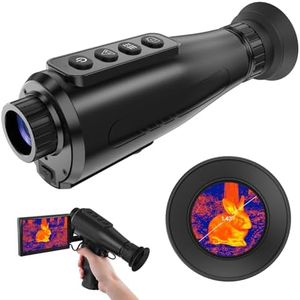
ACPOTEL NV30 Night Vision Monocular, Infrared Digital Night Vision with Sony Sensor for Full Color 100% Darkness with Rechargeable Battery, for Hunting&Surveillanc Support Video&Photo (5 * 35mm NV01)

Rating
7.3
Image Intensifier Tube
Resolution
Magnification

Most important from
28 reviews

Image Intensifier Tube
The image quality at night is outstanding, especially considering the price, delivering clear photos and videos with ease.
Resolution
Its bright LCD screen provides a crisp picture, enhancing the overall viewing experience even in low light.
Magnification
The fixed 4x base zoom can feel limiting indoors, and the narrow field of view means less peripheral visibility.
Field of View
The fixed 4x base zoom can feel limiting indoors, and the narrow field of view means less peripheral visibility.
Range
The powerful IR light allows visibility up to 200 yards in cloudy conditions, making it suitable for hunting and outdoor surveillance.
Battery Life
Rechargeable battery and included charging accessories add convenience, making it ready for extended use without extra purchases.
Durability and Weather Resistance
Users should be cautious as the device lacks waterproof gaskets, so it’s not suitable for use in rainy conditions.

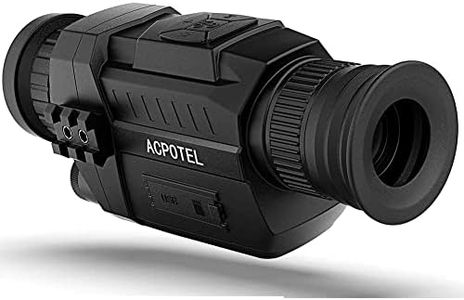
The ACPOTEL NV30 Night Vision Monocular offers a 5x magnification with a fairly narrow 2-degree field of view, which means it zooms in well but you see less around the edges. It is lightweight at about 1.26 pounds, making it reasonably easy to carry during outdoor activities like hunting or surveillance. Its lens is fully coated and paired with a 52mm eyepiece, which should help deliver clearer images. The device uses a rechargeable battery, which is convenient. It has manual focus, so you’ll need to adjust it yourself to get a sharp image.

While it includes a reflex finderscope for easier aiming, the claimed capability to see in full color in total darkness is quite ambitious, as most night vision devices typically show green or grayscale images. The monocular is compact but the objective lens size (around 40mm) is somewhat small, which might limit its brightness and range compared to larger models.

With decent customer ratings, this device can be a good budget option for those seeking a lightweight and rechargeable night vision monocular for casual use. However, users looking for professional-grade gen-2 clarity and range might find it less suitable.

Rating
7.3
Image Intensifier Tube
Resolution
Magnification

Most important from
28 reviews

Image Intensifier Tube
The image quality at night is outstanding, especially considering the price, delivering clear photos and videos with ease.
Resolution
Its bright LCD screen provides a crisp picture, enhancing the overall viewing experience even in low light.
Magnification
The fixed 4x base zoom can feel limiting indoors, and the narrow field of view means less peripheral visibility.
Field of View
The fixed 4x base zoom can feel limiting indoors, and the narrow field of view means less peripheral visibility.
Range
The powerful IR light allows visibility up to 200 yards in cloudy conditions, making it suitable for hunting and outdoor surveillance.
Battery Life
Rechargeable battery and included charging accessories add convenience, making it ready for extended use without extra purchases.
Durability and Weather Resistance
Users should be cautious as the device lacks waterproof gaskets, so it’s not suitable for use in rainy conditions.

Buying Guide for the Best Gen 2 Night Vision Monocular

When choosing a Gen-2 night vision monocular, it's important to understand the key specifications that will impact its performance and suitability for your needs. Night vision monoculars are used for a variety of activities such as wildlife observation, security, and navigation in low-light conditions. By understanding the key specs, you can make an informed decision and select the best model for your specific requirements.
Image Intensifier TubeThe image intensifier tube is the core component of a night vision device. It amplifies available light to create a visible image in low-light conditions. Gen-2 tubes offer better performance than Gen-1, providing clearer and brighter images with less distortion. When choosing a monocular, consider the quality of the image intensifier tube, as higher quality tubes will provide better performance in darker environments.
ResolutionResolution refers to the clarity and detail of the image produced by the monocular. It is usually measured in line pairs per millimeter (lp/mm). Higher resolution means a clearer and more detailed image. For general use, a resolution of around 30-40 lp/mm is sufficient, but for more demanding tasks like detailed observation or identification, look for a resolution of 50 lp/mm or higher.
MagnificationMagnification determines how much closer objects will appear when viewed through the monocular. Common magnification levels for night vision monoculars range from 1x to 5x. Lower magnification (1x-2x) provides a wider field of view, which is useful for navigation and general observation. Higher magnification (3x-5x) allows for better detail at a distance but can narrow the field of view and may require a steadier hand or tripod.
Field of ViewField of view (FOV) is the width of the area visible through the monocular, usually measured in degrees. A wider FOV allows you to see more of the surrounding area, which is beneficial for scanning and tracking moving objects. For general use, a FOV of 30-40 degrees is adequate. If you need to cover larger areas or track fast-moving subjects, look for a monocular with a wider FOV.
RangeRange refers to the maximum distance at which the monocular can effectively detect and identify objects. This is influenced by the quality of the image intensifier tube, resolution, and magnification. For general use, a detection range of 100-200 meters is sufficient. For more specialized tasks like surveillance or hunting, you may need a monocular with a longer range of 300 meters or more.
Battery LifeBattery life indicates how long the monocular can operate on a single set of batteries. Longer battery life is important for extended use, especially in remote areas where recharging or replacing batteries may not be convenient. Look for a monocular with a battery life of at least 20-30 hours for general use. If you plan on using the device for extended periods, consider models with longer battery life or the option to use external power sources.
Durability and Weather ResistanceDurability and weather resistance are important factors, especially if you plan to use the monocular in harsh or unpredictable environments. Look for models that are built with rugged materials and have water and dust resistance ratings. This ensures that the monocular can withstand rough handling and adverse weather conditions, providing reliable performance when you need it most.
Weight and SizeWeight and size are important considerations for portability and ease of use. Lighter and more compact monoculars are easier to carry and handle, making them ideal for activities like hiking and wildlife observation. However, smaller devices may have limitations in terms of features and performance. Balance the need for portability with the performance requirements of your intended use.

FAQ